
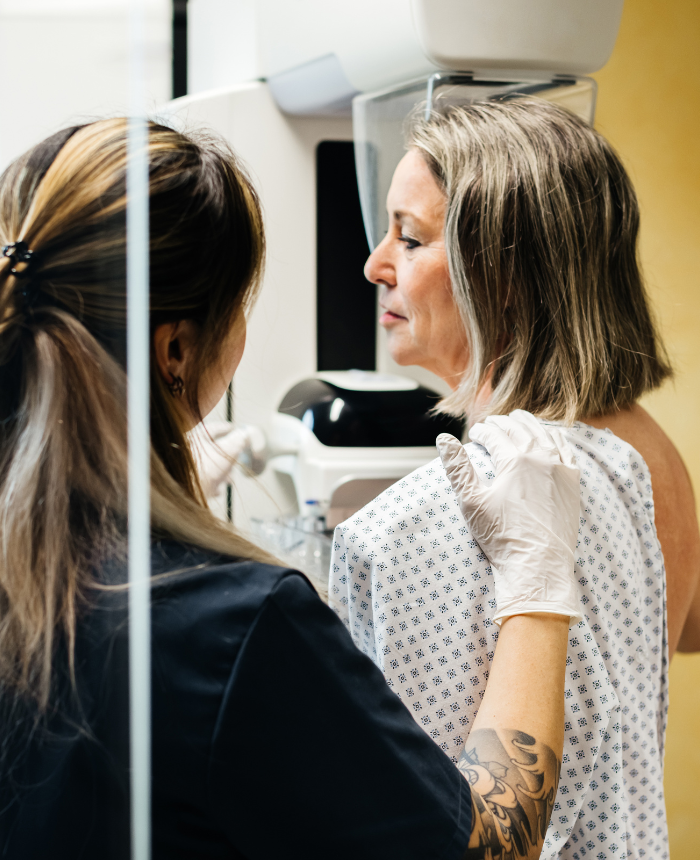
Breast Cancer
Cancers We Treat
Breast cancer is incredibly common—after skin cancer, it’s the most frequently diagnosed cancer in women in the United States. In 2023 alone, it is estimated that nearly 300,000 new cases of invasive breast cancer will be diagnosed, along with over 55,000 cases of early-stage ductal carcinoma in situ. On average, about 1 in 8 women in the U.S. will face a breast cancer diagnosis in her lifetime.
Breast cancer is a condition where abnormal cells in the breast grow uncontrollably and can form tumors. If left untreated, breast cancer can spread to other parts of the body. Although it is most commonly diagnosed in women, it’s important to remember that anyone with breast tissue, including men, can develop breast cancer.
Survival rates for breast cancer have been steadily rising, and deaths from the disease are decreasing. This progress is largely thanks to increased awareness, better screening techniques, and advancements in treatment options.
At Evansville Cancer Center, we understand that a breast cancer diagnosis can be overwhelming. That’s why we are dedicated to providing not only superior treatment, but also compassionate care throughout your journey. With innovative treatment options, ongoing support, and a personalized approach to your care, we strive to help you and your family restore balance and well-being.
What to Expect with Breast Cancer
Breast cancer is classified based on the specific cells in the breast that become cancerous, and understanding the type of breast cancer you have is essential for choosing the right treatment. Most breast cancers are carcinomas, which are tumors that start in the cells lining the breast’s milk ducts or lobules.
There are two main types of breast cancer: in situ and invasive. In situ breast cancer, such as ductal carcinoma in situ (DCIS), is considered a pre-cancer. It begins in the milk ducts but hasn’t spread to the surrounding breast tissue. While these cells are abnormal, they haven’t yet acted in a harmful or invasive way. If caught at this early stage, treatment can often prevent the cancer from progressing, offering a much better chance of a cure.
Invasive breast cancer, on the other hand, means the cancer has spread beyond the milk ducts or lobules into the surrounding breast tissue. This type of breast cancer has the potential to spread to other parts of the body, a process known as metastasis, which can pose a greater risk to the patient’s health.
Some invasive breast cancers include the following:
- Triple-negative breast cancer: An aggressive form of invasive breast cancer that lacks estrogen and progesterone receptors and doesn’t make extra HER2 proteins, accounting for about 12% of cases.
- Triple-positive breast cancer: Cancer that tests positive for estrogen and progesterone receptors and has too many HER2 proteins, making up about 10% of cases.
- Inflammatory breast cancer: A rare and aggressive type that causes the breast to appear swollen or inflamed, representing about 1%-5% of all cases
- Male breast cancer: While rare, men can develop breast cancer, and most cases are invasive ductal carcinomas.
If you’re looking for more information on breast cancer treatment near you, please contact us, as we’re here to help. Evansville Cancer Center, we are dedicated to providing personalized care close to home. For more information on what to expect during your first appointment and access to valuable resources, visit our For Patients page.
Risk Factors for Breast Cancer
There are several known risk factors for breast cancer, some of which you can control and others you cannot. While it’s helpful to understand these factors, it’s important to remember that having risk factors does not mean you will definitely develop breast cancer, and not having them doesn’t guarantee you won’t
Risk Factors You Can Change:
- Physical activity: Being physically active can help reduce your risk, while a lack of activity increases it.
- Hormone use: Certain forms of hormone replacement therapy (especially those combining estrogen and progesterone) and some oral contraceptives can increase your risk.
- Alcohol consumption: Drinking alcohol is linked to an increased risk of breast cancer. The more you drink, the higher the risk.
Risk Factors You Cannot Change:
- Age: The risk of breast cancer increases as you get older, with most cases diagnosed after age 50.
- Genetics: Inherited mutations in genes like BRCA1 and BRCA2 can significantly increase your risk of breast cancer and ovarian cancer. Having close relatives, like a mother, sister, or daughter, with breast cancer can raise your risk, especially if they were diagnosed at a younger age.
- Reproductive history: Having your first pregnancy after age 30, not breastfeeding, or never carrying a pregnancy to full term can raise your risk. Early menstruation (before age 12) and late menopause (after age 55) expose you to hormones longer, increasing your risk.
- Dense breast tissue: Women with dense breasts have a higher risk of developing breast cancer, and it can also make it harder to detect on a mammogram.
- Previous radiation therapy: Receiving radiation treatments to the chest, particularly in childhood or early adulthood, increases your risk later in life.
- Exposure to DES (diethylstilbestrol): Women who took DES during pregnancy, or whose mothers took it, have a higher risk of breast cancer.
Radiation Treatment for Breast Cancer
When it comes to treating breast cancer, radiation therapy is often a key part of the treatment plan, particularly after surgery. Radiation is used to target and destroy any remaining cancer cells that may not have been visible during surgery, helping to reduce the risk of the cancer returning.
External beam radiation therapy is the most common type of radiation therapy used for breast cancer. This method uses a machine outside the body to deliver focused radiation to the affected area. It is often recommended after breast-conserving surgery (lumpectomy) or in some cases after a mastectomy, especially if the tumor was large or cancer was found in the lymph nodes. The course of treatment usually lasts between 3 to 6 weeks, with appointments scheduled several days a week. External beam radiation is also used to target other parts of the body if the breast cancer has spread, such as the bones or brain.
Tumor Board
All of the diagnosis areas at Evansville Cancer Center work with a tumor board through Deaconess Cancer Services. A tumor board is part of a treatment planning process that leads to a comprehensive, interdisciplinary treatment plan that is specific to your needs. A group of doctors and other healthcare specialists will review your case and provide you with the best treatment options. This team may include:
- Pathologists
- Medical oncologists
- Radiation oncologists
- Surgical oncologists
- Genetic experts
- Nurses
- Social workers
At Evansville Cancer Center, our radiation oncologists are dedicated to working closely with you to create a personalized radiation treatment plan that considers the size, location, and stage of your breast cancer. We offer the latest in advanced breast cancer treatment near Evansville. Our team is committed to providing compassionate care, ensuring that your treatment is tailored specifically to your needs. We’re here to support you every step of the way.
Our Cancer Care Technologies
We treat patients using proven technologies in radiation oncology, including TrueBeam®, Image-Guided Radiation Therapy (IGRT), RapidArc®, Brachytherapy, and Intensity-Modulated Radiation Therapy (IMRT). Click below to learn about each of our cancer care technologies.
TrueBeam®
TrueBeam® Radiotherapy is a type of linear accelerator used to deliver precise external beam radiation.
IGRT
IGRT combines 3D images with the precise technology of either 3D-CRT or IMRT to pinpoint and treat cancerous tumors.
RapidArc®
Volumetric arc therapy (VMAT) is an advanced form of IMRT that allows a targeted, 3-D dose of radiation to be delivered directly to a tumor.
Brachytherapy
Brachytherapy is a form of radiation therapy where a temporary or permanent radioactive implant is placed inside the patient.
IMRT
IMRT is an advanced form of external radiation treatment that allows precise targeting of tumor cells.
Proven Technologies
We utilize proven technologies in radiation oncology, including TrueBeam®, IGRT, RapidArc®, Brachytherapy, and IMRT.