
Treatment Technology
SBRT
Radiation Therapy
Our radiation oncology center provides superior treatment and compassionate care to patients diagnosed with cancer. In addition to continuing education and ongoing support, we offer innovative treatments close to home.
Stereotactic body radiation therapy, also known as SBRT, is a form of external beam cancer radiation treatment that delivers highly targeted doses of radiation directly to cancer cells. In comparison to other radiation therapies, such as IMRT, SBRT delivers the optimal dose of radiation over a short time period, with treatments often measured in days rather than weeks.
SBRT can sometimes be used to treat small early-stage tumors (including those in the lung, prostate, and pancreas), or cancers that have spread to the lung, liver, or spine.
What Happens During SBRT Treatment?
First, your healthcare team will utilize imaging and CT scans to map out a 3-D outline of the cancerous cells. Based on this outline, your team will design a targeted treatment plan that concentrates radiation therapy directly on the tumor while avoiding the nearby healthy tissue. This treatment plan will include determining exactly what position your body needs to be in during therapy.
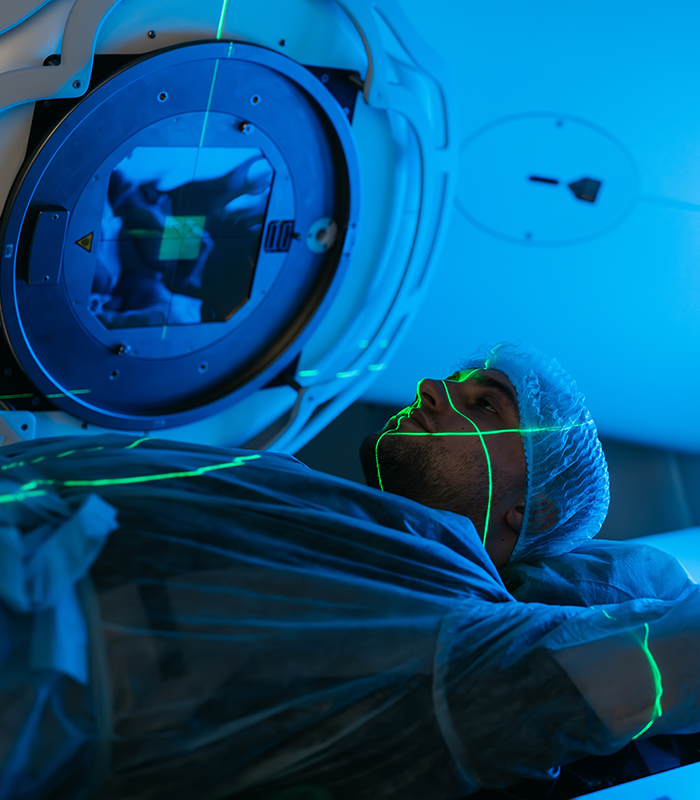
During SBRT treatment, your healthcare team may provide you with a specialized mold of your upper body to help you remain in the most optimal position for your treatment. Most patients will be positioned with their arms raised above their head, lying flat on the treatment table. If you feel uncomfortable during any part of this process, be sure to tell your healthcare team so they can make adjustments for your comfort.
Once you are positioned appropriately, the linear accelerators will turn on. You won’t be able to see or feel the beams of radiation, but you may hear the machine as it moves around you. Each beam will aim toward the specific target area, passing safely through healthy tissue to deliver the full dose of radiation to the location where the beams meet.
Each treatment can take up to an hour, but stereotactic body radiotherapy is usually an outpatient procedure and you should be able to return home afterward.
Advantages of SBRT
Stereotactic body radiation therapy offers a number of advantages over conventional radiation treatment. While traditional radiation is typically delivered in small doses over several weeks, SBRT is usually completed in five or fewer sessions. Unlike surgery, it does not require anesthesia, and the shorter radiation schedule helps reduce interruptions to daily life. This makes it easier for patients to continue with other treatments without delays or complications.
SBRT is also known for being remarkably precise. It allows healthcare providers to target tumors accurately while limiting radiation exposure to nearby tissues and organs. This focused approach often results in fewer side effects and improved outcomes compared to conventional radiation.
SBRT can be a noninvasive alternative to surgery for some patients, offering outcomes comparable to surgical treatment in certain early-stage cancers like those of the lung and prostate—without the need for any incisions. It may also help control cancers that have spread by shrinking tumors and slowing their growth and, in some cases, supporting the body’s immune response. Recovery is typically fast, with most people returning to normal activities within a day or two and resuming eating and drinking right after treatment.
What Are the Side Effects of SBRT Radiation Therapy?
Side effects for SBRT treatment are often short-lived and happen directly after treatment. These can include:
- Swelling and skin changes: Swelling or skin changes near the treatment site can occur, causing irritation, itchiness, or slight pain.
- Fatigue: It is not uncommon to experience extreme tiredness and fatigue in the days directly after receiving SBRT treatment.
- Nausea: Nausea or vomiting might occur if treatment for a tumor is near the digestive system.
More rarely, some patients experience side effects that occur months or even years after SBRT therapy has occurred. These can include changes in the organs targeted by the treatment, as well as swelling in the arms or legs, or weakening of the bones.
Our Cancer Care Technologies
We treat patients using proven technologies in radiation oncology, including TrueBeam®, Image-Guided Radiation Therapy (IGRT), RapidArc®, Brachytherapy, and Intensity-Modulated Radiation Therapy (IMRT). Click below to learn about each of our cancer care technologies.
TrueBeam®
TrueBeam® Radiotherapy is a type of linear accelerator used to deliver precise external beam radiation.
IGRT
IGRT combines 3D images with the precise technology of either 3D-CRT or IMRT to pinpoint and treat cancerous tumors.
RapidArc®
Volumetric arc therapy (VMAT) is an advanced form of IMRT that allows a targeted, 3-D dose of radiation to be delivered directly to a tumor.
Brachytherapy
Brachytherapy is a form of radiation therapy where a temporary or permanent radioactive implant is placed inside the patient.
IMRT
IMRT is an advanced form of external radiation treatment that allows precise targeting of tumor cells.
Proven Technologies
We utilize proven technologies in radiation oncology, including TrueBeam®, IGRT, RapidArc®, Brachytherapy, and IMRT.