
Treatment Technology
VMAT
Radiation Therapy
At Evansville Cancer Center, we offer local state-of-the-art radiation therapy. Our Board-certified radiation oncologists and highly trained clinical staff have treated thousands of patients and specialize in providing personalized treatment plans.
But our goal is to provide much more than just radiation therapy; we also offer education and compassionate, ongoing support so that our patients and their families can get back to their lives as soon as possible.
One of the treatments we offer is volumetric-modulated arc therapy, or VMAT. VMAT uses a rotating machine to deliver multiple beams of radiation from outside of the body. The process is targeted and comparatively quick, which makes it a good treatment option for cancers that are oddly shaped or close to sensitive vital organs. These might include:
- Prostate cancer
- Lung cancer
- Head and neck cancer
- Brain cancer
What happens during VMAT?
VMAT involves using X-rays generated by a machine called a medical linear accelerator, or LINAC, to deliver small beams of radiation at different intensities as the machine rotates around you. During the rotation, the machine continually adjusts the shape and strength of the radiation as needed.
Before your treatment, your care team will meet with you to take a series of 3D images, usually including CT scans, MRI, and/or PET scans. These images allow us to see the size and location of the tumor so we can determine the best way to target it while keeping the surrounding tissue as healthy as possible.
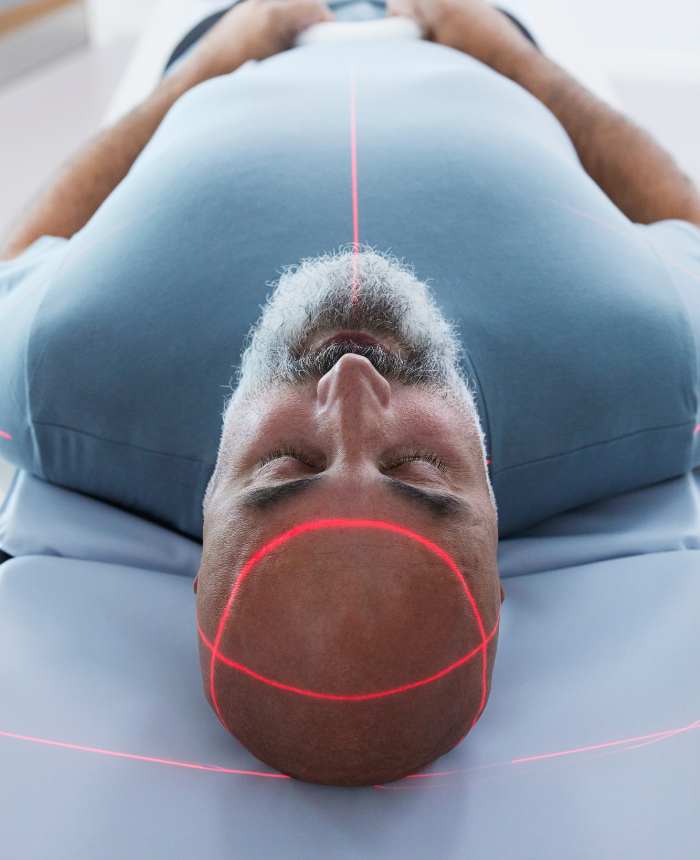
You will also undergo a simulation, or “sim,” during which we will help you find the right position on the treatment couch so that the LINAC machine can hit the precise location of the tumor with the radiation. This might include marking the location on your body and getting accustomed to special accessories, such as a mold or mask, that will help you stay in place during the procedure.
During the treatment, your radiation therapist will use the LINAC machine to deliver customized doses of radiation as the machine rotates around you. Depending on your situation, your session may involve one rotation or several. The process is painless, and your radiation therapist will be there the entire time to answer questions and help you get comfortable.
The whole treatment generally takes about twenty minutes. Most of that involves preparation; the actual radiation exposure is usually only about two minutes. You should be able to leave our office the same day and return to your usual activities.
You may need daily VMAT sessions for several weeks. Your doctor will go over your treatment plan with you and make sure you know what to expect.
The advantages of VMAT
The biggest advantages of VMAT are its precision and speed. VMAT precisely targets the cancer, which helps minimize radiation exposure to healthy nearby tissue. And because the therapy generally only takes about two minutes, the whole process is quick, which reduces the amount of time you spend in a session.
What are some side effects of VMAT radiation therapy?
Not everyone experiences side effects from radiation treatment, and the treatment itself is usually painless. But it’s a good idea to keep an eye out for anything unusual after your session and talk to your care team as soon as possible if you have any concerns. We’re here to help!
Possible side effects include:
- Fatigue. Be sure to get plenty of rest, and request help with your daily tasks if you need to. Try to eat well and do some light to moderate activity, if you can.
- Nausea. Your doctor may prescribe anti-nausea medication to help manage this symptom. They may also have suggestions for ways to reduce stress and settle your stomach.
- Diarrhea. Depending on the severity, your doctor may suggest medication. You should also focus on staying hydrated and eating smaller meals more often.
- Headaches. Relaxing with a cold compress can help. Be sure to also let your care team know right away if you’re experiencing headaches so they can rule out any other cause or provide medication, if necessary.
- Hair loss. Stick with mild shampoos and soft hairbrushes. Consider wearing a hat or scarf to help you stay comfortable.
- Skin irritation. Use gentle skin products with aloe or lanolin, and make sure to let your doctor if you notice a rash or anything else unusual.
Our Cancer Care Technologies
We treat patients using proven technologies in radiation oncology, including TrueBeam®, Image-Guided Radiation Therapy (IGRT), RapidArc®, Brachytherapy, and Intensity-Modulated Radiation Therapy (IMRT). Click below to learn about each of our cancer care technologies.
TrueBeam®
TrueBeam® Radiotherapy is a type of linear accelerator used to deliver precise external beam radiation.
IGRT
IGRT combines 3D images with the precise technology of either 3D-CRT or IMRT to pinpoint and treat cancerous tumors.
RapidArc®
Volumetric arc therapy (VMAT) is an advanced form of IMRT that allows a targeted, 3-D dose of radiation to be delivered directly to a tumor.
Brachytherapy
Brachytherapy is a form of radiation therapy where a temporary or permanent radioactive implant is placed inside the patient.
IMRT
IMRT is an advanced form of external radiation treatment that allows precise targeting of tumor cells.
Proven Technologies
We utilize proven technologies in radiation oncology, including TrueBeam®, IGRT, RapidArc®, Brachytherapy, and IMRT.